Understanding the Blueprint: Aligning the Massive Wisdom Self-Leadership Framework with Research Insights
Understanding the Blueprint: Aligning the Massive Wisdom Self-Leadership Framework with Research Insights
Nov 10, 2026
In a fast-evolving digital economy, relying entirely on top-down institutional mandates to guide your career can easily lead to stagnation and burnout. Navigating modern workplace pressures requires a shift toward self-direction.
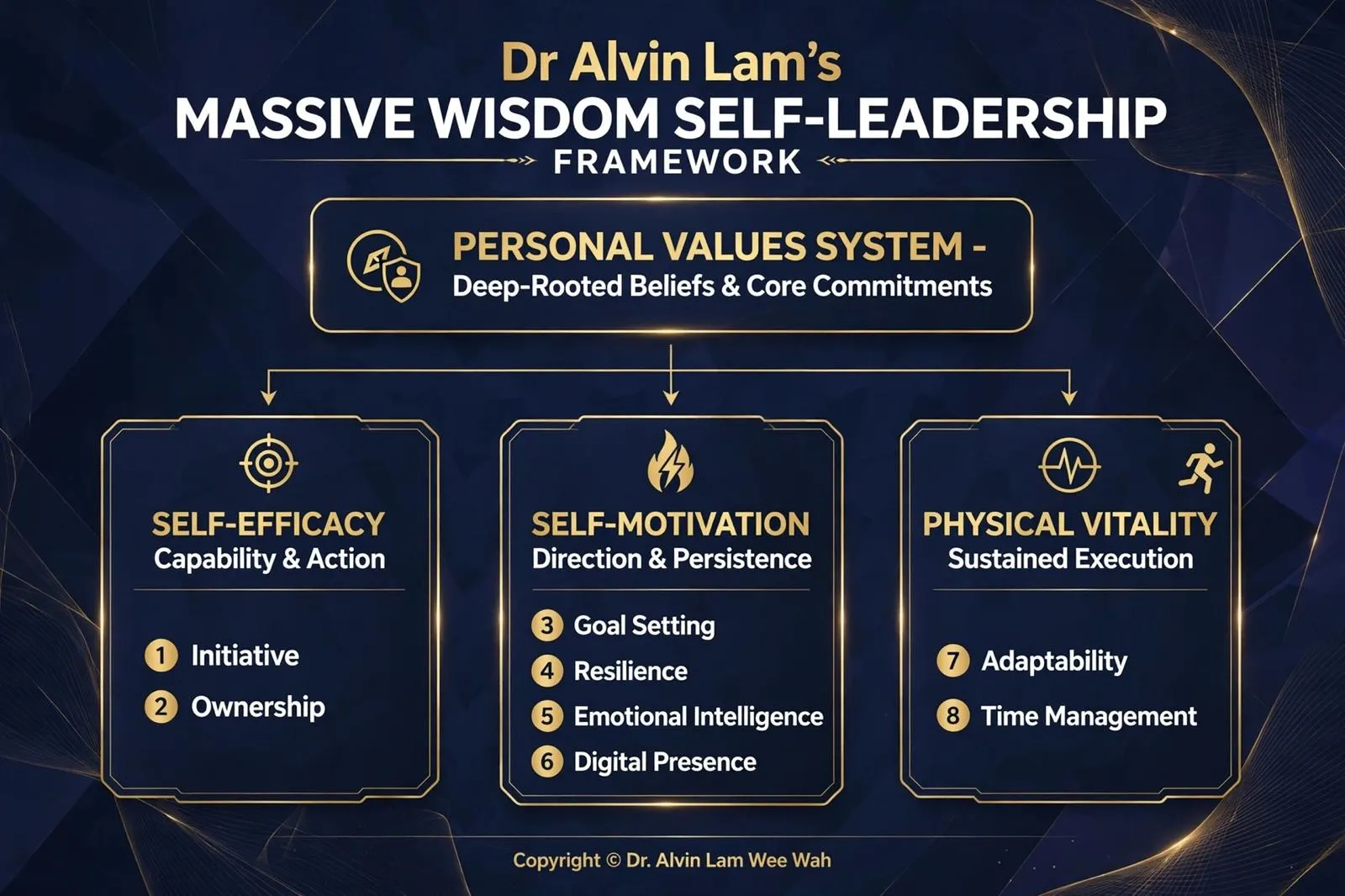
The Massive Wisdom Self-Leadership Framework offers a structured model designed specifically for this environment. Derived from Lam's (2026) mixed-methods doctoral study of professionals in Singapore’s digital sector, the framework illustrates how psychological resources and physical energy interact to support self-leadership behaviors. It coordinates an individual's psychological and physiological resources, shifting the focus from external corporate management to internal, autonomous execution.
The framework operates under a core strategic mantra: “Do the right things first, then make things right later on.”
The Architecture: 3 Research Variables, 8 Operational Pillars
The framework organizes eight operational pillars across three core research domains, driven fundamentally by a foundational Personal Values System.
Phase 1: Action — Activating Self-Efficacy
The quantitative findings indicate that self-efficacy—the belief in one's own capability—is significantly associated with self-leadership behaviors. When professionals feel confident in their skills, they are more likely to take the first step. The framework addresses this dynamic through two pillars:
- 1. Initiative: The practical baseline of self-efficacy. When you trust your capabilities, you do not wait for explicit direction; you proactively address gaps and initiate tasks independently.
- 2. Ownership: A strong belief in your capability supports personal accountability. You assume absolute responsibility for outcomes, shifting from a passive task-executor to an active, autonomous coordinator of your career.
Phase 2: Direction — Anchoring Meaning-Driven Self-Motivation
Interestingly, the study found that simply being outcome-focused (focusing strictly on targets or metrics) does not show a direct relationship to self-leadership behaviors. Instead, meaning-driven self-motivation serves as a secondary driver that corresponds with prolonged engagement. Four pillars help structure this internal direction:
- 3. Goal Setting: In this framework, goals are tied directly to your Personal Values System. Rather than chasing arbitrary corporate metrics, you establish purposeful targets that help sustain focus during organizational changes.
- 4. Resilience: Purpose supports long-term commitment. When work aligns with internal meaning, resilience acts as a psychological buffer, providing the stamina to persist through digital disruptions and setbacks.
- 5. Emotional Intelligence: Navigating high-pressure environments requires internal awareness. This pillar focuses on recognizing and managing stress, anxiety, or frustration to keep your efforts constructively aligned with your goals.
- 6. Digital Presence: In a hyper-connected workplace, your digital footprint reflects your professional identity. This pillar focuses on projecting authentic professional integrity rather than reacting to short-term, superficial trends.
Phase 3: Sustainability — Cultivating Physical Vitality
A key insight from the qualitative data is that physical vitality may function as a conditioning mechanism for self-leadership. Psychological motivation and self-efficacy are difficult to maintain without adequate physical energy. The study suggests that physical vitality accompanies the integration of internal resources, functioning as the biological infrastructure that translates mental drive into long-term, daily execution. The framework manages this via two pillars:
- 7. Adaptability: Adapting to unpredictable market shifts demands both mental agility and physical stamina. Maintaining a physical baseline allows you to pivot smoothly without experiencing chronic exhaustion or burnout.
- 8. Effective Time Management: Within this framework, managing time is closely linked to managing personal energy. Optimizing your productivity windows around your body's physical peaks allows you to sustain consistent action across demanding work cycles.
Implementation Strategy
To successfully implement the framework, align your professional routine sequentially:
- Define the Foundation: Deeply root your daily work in a clear Personal Values System to unlock authentic, meaning-driven Self-Motivation.
- Build the Capability: Actively develop competence in your role to strengthen your Self-Efficacy, unlocking the confidence to take Initiative and Ownership.
- Protect the Engine: Maintain steady physiological routines (rest, movement, nutrition) to preserve your Physical Vitality, fueling your ability to remain Adaptable over time.
Developing these internal resources gives you a structured, research-backed strategy to safely and sustainably navigate the demands of the digital era.
References
Lam, W. W. (2026). Leading from within: The impact of self-awareness, self-motivation, and self-efficacy on self-leadership behaviors among digital professionals in Singapore (Doctoral dissertation, Golden Gate University). ProQuest Dissertations & Theses Global. (Publication No. 32789716).
Massive Wisdom Group. (n.d.). Self-leadership in a disruptive digital era framework. Massive Wisdom Group Blog.